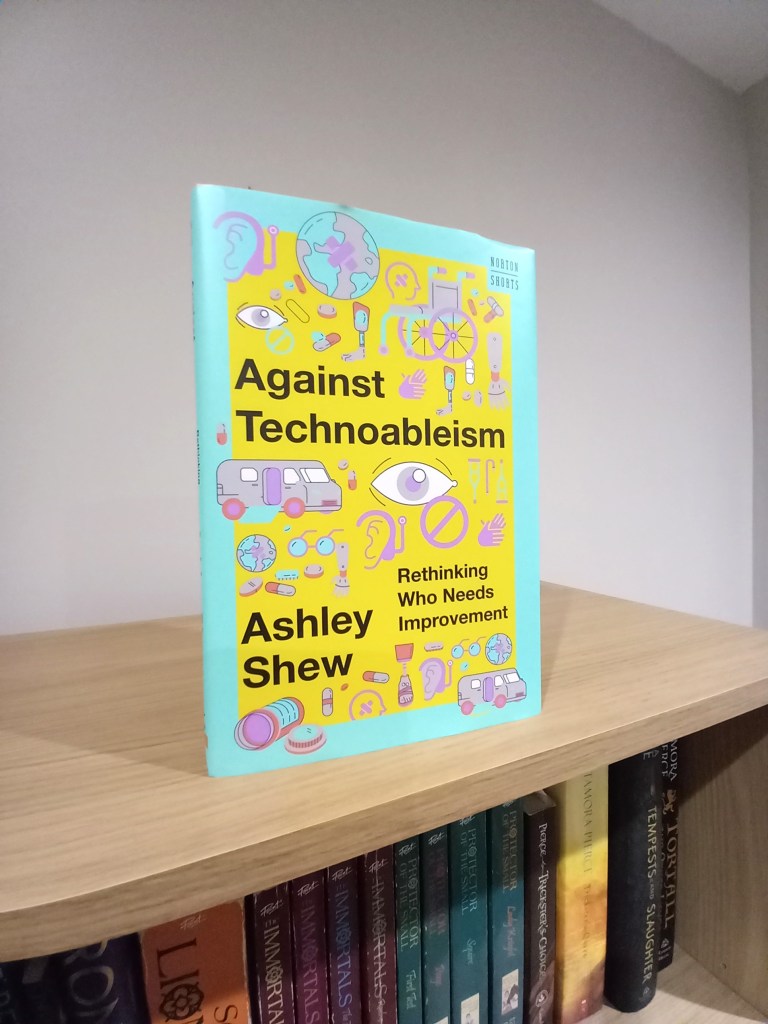
Against Technoableism presents Ashley Shew’s insights into how technology produced for disabled people largely does not include its target audience in the design process at all. Shew starts with some of the tenets of disability justice discourse then uses examples to demonstrate to readers how technoableism manifests.
To give one example, huge amounts of money are being spent on exoskeleton technology to help people walk again, yet, Shew argues, many wheelchair users find manoeuvring in a wheelchair with their disability easier and less painful than trying to walk. Social stigma and many areas of the built environment being inaccessible to wheelchair users remain issues where progress is slow. It is the resolution of these issues that would impact lives with the best outcomes.
I found the chapter on technology for amputees the most interesting with Shew’s lived experience demonstrating how artificial limb technology she uses is sold and personalised. Shew explains how bulk production of this kind of technology leads to worse products for its users because the fit of each leg, arm or hip needs to be completely individual. This chapter and the next, on neurodivergent people resisting an American charity which encourages the controversial topic of applied behavioural analysis therapy, are where Shew hits some real momentum with her argument. Note trigger warnings for the chapter on neurodiversity as it discusses abuse and torture of autistic people.
As someone who has lived experience of disability and would consider themselves fairly well-read on areas of disability that aren’t my own experience, this book expanded my view. Shew’s writing style is very readable and this slim volume holds a good dose of in-depth discussion on social justice alongside examples of disability tech and the people that use it. I was impressed with how Shew detailed her argument within 135 pages and will definitely be looking out for more short reads on social sciences from the Norton Shorts series in future.
If disability and technology is a topic you’re interested in, I think you’ll also enjoy Hybrid Humans by Harry Parker. You can find my review here.
 Tori Pearmain