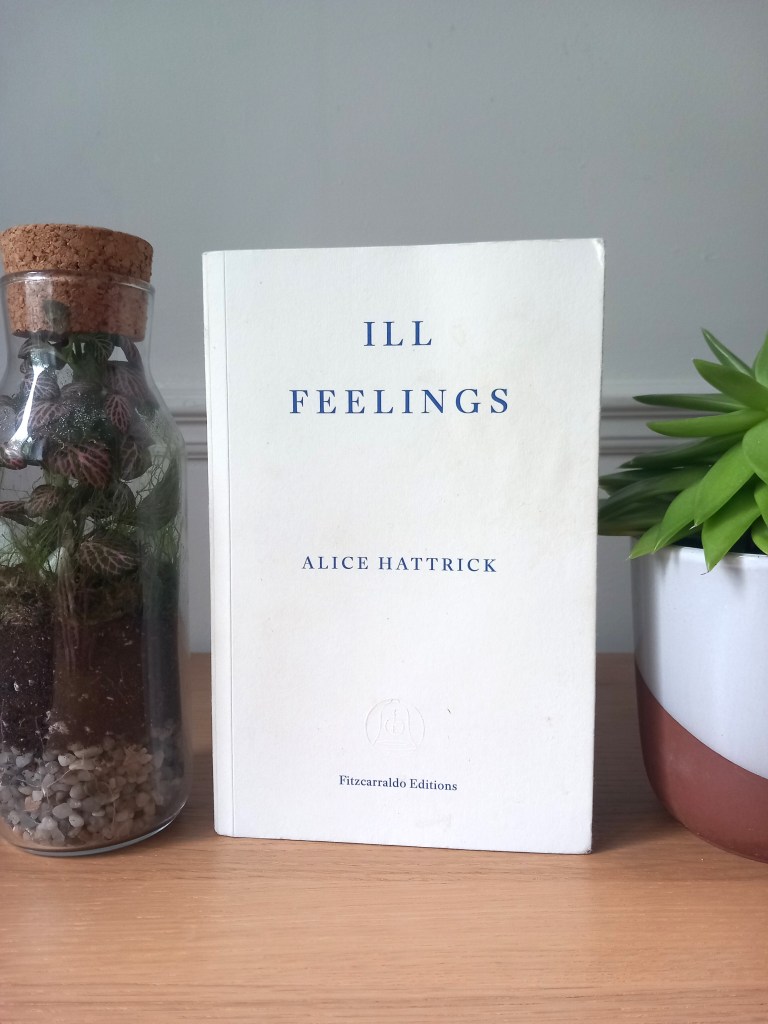
“Illness occupies the mind and body, like a hobby, a job, or a subject you study.”
There are many quotes I could have picked from Alice Hattrick’s book of essays, Ill Feelings, to open this review. I liked this one because it shows the all-encompassing nature of chronic illness. Whilst it is such a personal experience, each illness has a history, a body of people living with it, and a future which can be influenced by societal, environmental, and political factors.
I remember when possible diagnoses started to be put on the table for me. The first time a treatment brought positive results, I became a student of my illness. I stuck to reputable sources as much as possible and through abstracts of papers and information from charities, learned not only the symptoms and possible treatments, but also the history, politics and sociology of my thyroid disease. Much of Hattrick’s book focuses on ME/CFS through this lens, an illness which has been horribly misunderstood in the past and for which patients continue to struggle to get diagnosed and receive adequate treatment.
Many of the early essays examine the origins of patients with “invisible” illness not being believed. There is an overwhelming number of accounts of patients describing symptoms of illness and being treated for hysteria. One example is Toni Jeffreys who was admitted to a mental hospital because she told doctors she had a crab in her stomach. Years later, a very large stomach ulcer was found inside her. Hattrick remarks, “It was as if she had had too much flair for metaphor.”
I particularly enjoyed the essays which touched on Hattrick’s view that “pain lends itself to metaphor” – one that I agree with. Our language for pain, experienced through nociception, a separate sense to touch, seems so stunted compared to the language we have for other senses (in English at least, I’d love to hear if other languages communicate pain in a richer way). Pondering pain means drawing on imagery that overwhelms other senses. Because of this, it comes as no surprise that Hattrick has a wealth of famous writers to draw on for a history of illness from the patients’ view, including Virginia Woolf, Elizabeth Barrett Browning, and Emily Dickinson.
Some of the final essays, Drained, Unrecovery, and No, turn to contemporary issues, three of which I’d like to highlight, in the hopes it may urge you to read Ill Feelings. Firstly, Hattrick highlights the importance of the names of diseases. She describes the findings of a study where medical trainees were more likely to attribute patient’s illness to medical causes if the name ME (Myalgic Encephalomyelitis) was used (as opposed to Chronic Fatigue Syndrome), “What is it about chronic fatigue syndrome that is so unbelievable…is it because fatigue is a symptom not a cause? Is it that a syndrome is not a disease?”
Secondly, the struggle of ME/CFS patients spending decades trying to get outdated and ineffectual NICE guidelines overturned (following some suspect reasons those guidelines were instated in the first place) is so frustrating. For those unfamiliar, NICE guidelines are the framework given to GPs in the UK to advise them on the course of action to follow for treatment of all illnesses. Several factors are taken into consideration, including how much supporting evidence from clinical trials there is (which may not exist for underfunded illnesses) and cost of treatment. Hattrick’s essays shed light on the influence that those in the committee have over said guidelines. These are people who are proponents for specific treatments or have affiliations to certain companies providing treatments.
Thirdly, Hattrick gives voice to issues experienced during and following the COVID-19 pandemic.
“Advice columns on how to stave off boredom when stuck at home appear, except no one asked disabled and chronically ill people how they have dealt with ‘missing out’ for years.”
“Accommodations that would have enabled people with chronic illness, mental health issues and disabilities to continue their social life, education and meaningful employment…swing into action for able people in a matter of days.”
If we are to strive for an inclusive and empathetic society, we need to discuss how disabled people were treated during the pandemic and need more able-bodied people to understand that parts of what they experienced during the COVID-19 pandemic is everyday life for some disabled people.
Contained within the pages of this unassuming volume is the history, politics, and sociology of ME/CFS and other “invisible” illnesses. Yes, all of these are difficult topics – this book was one of the hardest I’ve read in the last few years. But the conversations that Ill Feelings starts are ones that patients, medical professionals, policymakers, and pharmaceutical companies desperately need to have, and the sooner, the better.
 Tori Pearmain