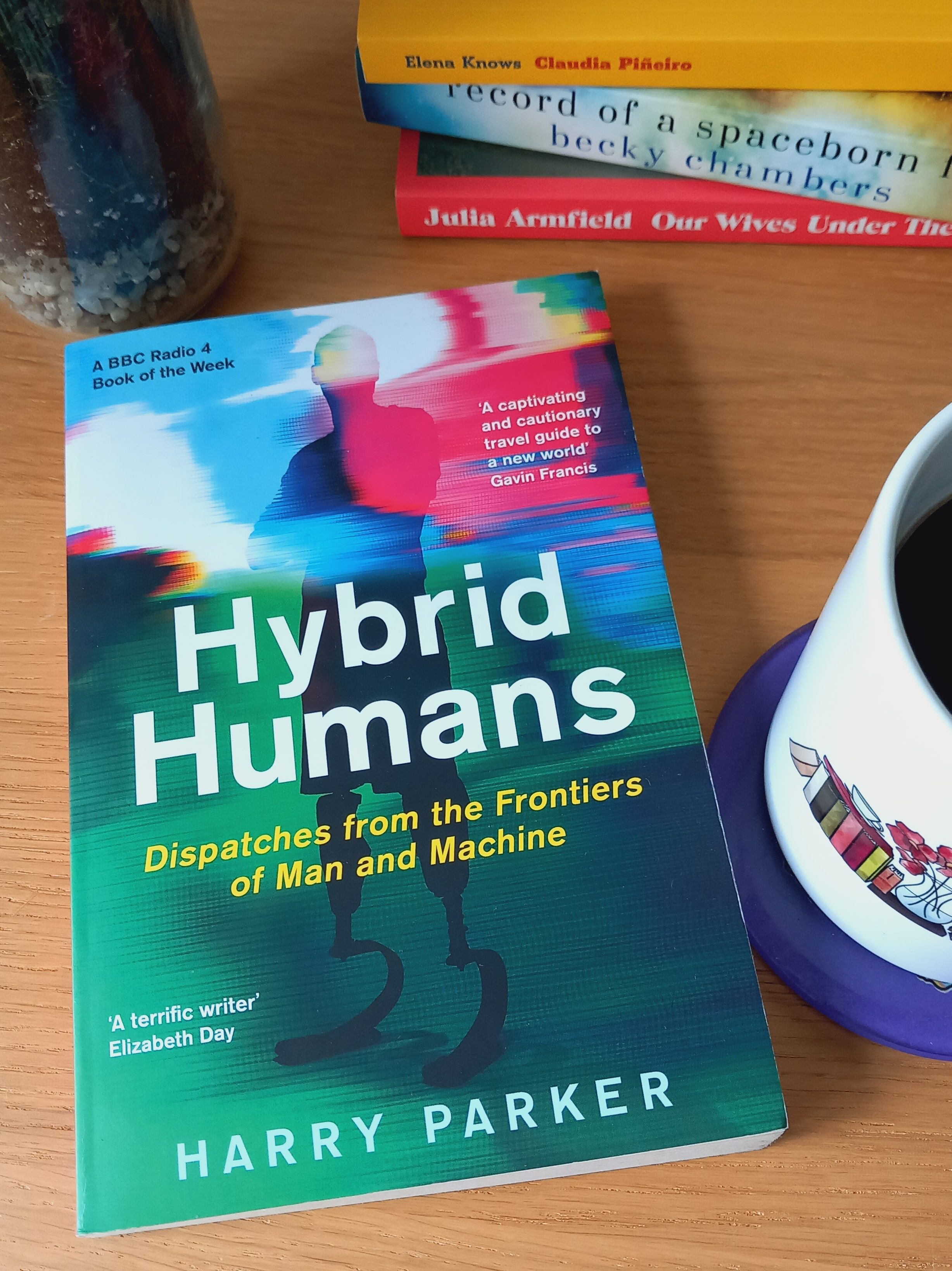
My reading of Hybrid Humans coincided with going to a museum exhibition about gene editing. At the end of the exhibition, I was asked to write a note on what I’d most like the scientists working on this area to consider. With this book in mind, I had the courage to write: “Please include disabled people in these discussions. They are so often the pioneers trying new technology and medicines and so rarely the people being asked what they think about it.”
Harry Parker provides an overview of a breadth of technology created for disabled people, starting with the iron lung used during the polio epidemic of the 1940s and 50s. The chapters on prosthetics are particularly informative with insight from Parker’s lived experience of limb loss adding a lot of depth. I found the discussion about what technology makes it into public consciousness particularly engaging, from the app that can read a blind man’s mail aloud to him on the more familiar end of the spectrum to RFID technology which would allow us to microchip ourselves and have our card details etched into our wrists on the other end (yes, the technology exists already but many people don’t want it when faced with the reality).
My favourite part was learning about the Alternative Limb Project run by an artist who creates bespoke limbs with creative designs and bright colours. With the book charting into territory involving the Purple Pound and thinking about assistive aids as business, this was a refreshing end showcasing artistic engineering. You can find out more about the project here.
What really makes the book is Parker’s journey coming to terms with his own ableism. It takes courage to show the version of yourself that had just become ill and wasn’t dealing very well with the consequences. I remember the reality of ableism falling on my shoulders hard and fast in the first year I became chronically ill and then all over again the second year when I started opening up to people about my illness. For those readers unsure of some of the feelings Parker has in the first chapter where he describes the events that led to the loss of his legs, rest assured that there is growth in his journey exploring disability. Feel free to check his Note on Ableism at the back of the book if you’d like to see where this is going ahead of time.
If you have an interest in the future of science and technology and are keen to find a read that will showcase a range of disabled people, pick up Hybrid Humans by Harry Parker. For any non-fiction book clubs, this would make a great pick (it’s short too!).
 Tori Pearmain